What is Depreciation?
When you purchase a car, you are trading one asset (cash) for another asset (automobile). At the time of the trade, the value of the cash you traded away should be equal to the value of the automobile you purchased. In other words, no expense should occur at the time of the trade (if only that were true in all cases).
An expense occurs as the value of the automobile drops below the value of the cash you traded for it. This drop in value is called "Depreciation."
How to Calculate Car Depreciation
You can calculate car depreciation in several ways:
- Age of vehicle.
- Cost per mile.
- Difference between the purchase price and the selling price (straight line).
Method #1: Depreciation Based on Age of Vehicle
This method is based on the purchase price of the vehicle, its current age, and its estimated yearly depreciation rates.
However, while the price and age of the vehicle are known values, its annual depreciation rates are speculative and vary wildly between makes and models. Therefore all we can do is to estimate the depreciation rates based on an average of all reporting agencies (they also vary wildly).
Based on my research, the consensus seems to be that new cars depreciate an average of 24% in the first year and 15% in the remaining years.
The car depreciation formula for this method is as follows:
- For year #1, multiply the purchase price by the first year depreciation rate and subtract the result from the price.
- For all remaining years, multiply the previous year's reduced value by the current year's depreciation rate, and subtract the result from the previous year's value.
So if you purchased a car for $30,000 and you want to know how much your new car will depreciate after five years, here is how you would calculate the value based on the above formula yearly depreciation rates:
Year #1 ending value = 30000 - (30000 x 0.24) = 30000 - 7200 = $22,800
Year #2 ending value = 22800 - (22800 x 0.15) = 22800 - 3420 = $19,380
Year #3 ending value = 19380 - (19380 x 0.15) = 19380 - 2907 = $16,473
Year #4 ending value = 16473 - (16473 x 0.15) = 16473 - 2471 = $14,002
Year #5 ending value = 14002 - (14002 x 0.15) = 14002 - 2100 = $11,902
And here is a car depreciation curve showing how the value of the vehicle continues to decline over time.
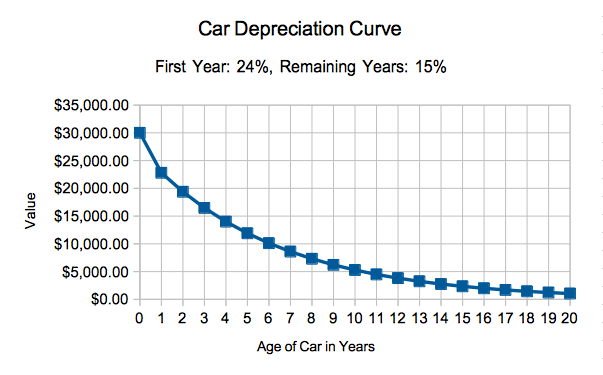
Of course, the above is only an estimate as the actual depreciation varies depending on which vehicle you buy, how many miles per year you drive the vehicle, and how well you take care of the vehicle.
Method #2: Depreciation Based On Cost Per Mile
As reported by the AAA, the average annual cost of owning and driving a vehicle in 2018 was $8,849 -- 40% of which ($3,540) they attributed to depreciation. And since the study was based on 15,000 miles driven per year, this would put the average depreciation cost per mile at $0.24 ($3,560 / 15,000).
Here is a little calculator I put together to help you estimate your depreciation cost per mile based on the AAA's driving costs findings.
Here again, the actual cost of depreciation will depend on many dependent factors.
Method #3: Straight Line Depreciation
This method subtracts the expected salvage value from the purchase price of the vehicle.
Based on the earlier example, if you expected to own the $30,000 vehicle for 5 years, and estimated you could sell it 5 years from now for $12,000, the straight line depreciation would be calculated as follows:
| Straight Line Depreciation | |
|---|---|
| Purchase price: | $30,0000 |
| Salvage value (selling price): | $12,000 |
| Depreciation expense (purchase - salvage): | $18,000 |
| Depreciation percentage (depreciation / purchase): | 60% |
| Annual depreciation (depreciation / years): | $3,600 |
You can also use the straight line method to estimate the depreciation cost per mile, like this:
| Straight Line Miles Depreciation | |
|---|---|
| Purchase price: | $30,0000 |
| Salvage value (selling price): | $12,000 |
| Depreciation expense (purchase - salvage): | $18,000 |
| Beginning miles: | 0 |
| Salvage miles: | 75,000 |
| Depreciation miles (salvage miles - begin miles): | 75,000 |
| Depreciation cost per mile (depreciation / depreciation miles): | $0.24 |
Since numerous unknown variables come into play when estimating the cost of depreciation, the only time you will be able to determine the exact size of the expense is when you sell, trade, or scrap your vehicle. Only then will you know for sure just how much your automobile dropped in value since you purchased it.
What Are The Unknowns?
As to what variables are "unknown," they would include variables such as the economy, the price of gasoline, the number of miles you drive your car, the condition of the vehicle, and the demand for the particular make and model of the vehicle.
Considering all of these unknown variables, the goal of the car depreciation calculator is not to calculate the exact amount by which a car will drop in value.
Instead, the goal of the calculator is to provide you with a means to compare depreciation costs for various car buying scenarios and to show you how these costs, plus the forfeited potential future wealth, can add up throughout your lifetime.
The Most Expensive Car Buying Scenario
Earlier I said that when you trade cash for an automobile, it's presumed that the value of the car is equal to the amount of money that was traded for it. In reality, there is only one buying scenario where that presumption would be somewhat correct -- a scenario wherein you purchase the car from an individual.
Used-Car Instant Value Drop
If you purchase a used car from a car dealer, the value of the automobile will instantly drop in value the moment you drive the car off the lot.
That's because the auto dealer marked up the value of the used car to include a profit margin.
If you want to know just how much that drop is, immediately drive your just-purchased car to a competing dealer and ask how much cash they'd be willing to give you for the vehicle.
But wait, that drop in value is nothing compared to the decrease in value you will experience if you purchase a "new" car.
New-Car Instant Value Drop
When you purchase a "new" car, the "new" car instantaneously becomes a "used" car!
So not only will the new car's value drop by the amount of the dealer's profit margin, but it will also plummet by the reduction in the perceived value ("used" is far less appealing than "new"). Altogether, this warp-speed depreciation that occurs the moment you drive a "new" car off of the lot can run in the 10-30% range. Ouch!
If you add to that the fact that cars depreciate faster in their early years and slower in later years, buying a "new" car every 1-3 years will cost you a fortune in hyper, warp-speed depreciation, and foregone interest earnings. You can test these types of scenarios in the future car value calculator on this page, and you will see what I mean.
I know middle-income individuals who buy new, $30,000-$50,000 vehicles every 1-2 years. I could retire on what they are throwing away in depreciation and foregone interest income.
The Least Expensive Car Buying Scenario
Most financial "experts" will tell you that the key to getting the most value out of your exchange of cash for an automobile, is to purchase a car that has a low (slow) rate of depreciation (a.k.a., high resale value).
What's wrong with that advice? Well, considering that the cars that have the lowest depreciation rates also tend to have the highest sticker prices, any depreciation costs you save may be largely offset by the increased price of the car and higher insurance premiums.
If you really want to lower the depreciation cost of owning a vehicle, the key is to either buy a new car and hold on to it for an extended period of time (say 8-10 years), or to buy a slightly used car often enough to avoid the costly ongoing repairs that can come with heavily used vehicles.
Of course, if you can walk or ride a bike to work, or you have access to public transportation, you can eliminate car depreciation costs.